
Migrant smuggling is a dynamic global criminal activity. Poverty, social and political instability, as well as the limited availability of legal migration routes, push people towards criminal networks to facilitate their unauthorised entry, transit or stay in the EU. The journey to the EU can be extremely dangerous and smugglers frequently expose migrants to both life-threatening risks and violence. The loss of lives in the Mediterranean Sea demonstrates the need for an assertive and urgent response from the EU.
Smuggling of migrants by sea is one of the most dangerous forms of migrant smuggling and often requires serious humanitarian assistance. To save the lives of those in distress at sea, EU countries' coastguards and naval services make major efforts with the assistance of the European Border and Coast Guard Agency (FRONTEX).
Most irregular migrants originally enter the EU legally on short-stay visas, but remain in the EU for economic reasons once their visa expired. Effective and credible management of external borders is essential. The Commission adopted on 14 March the Communication establishing the multiannual strategic policy for European integrated border management, providing policy priorities and strategic guidelines, among other components, on SAR inter alia to maintain a high level of security by using information technology (such as the Visa Information System) and biometric features (e.g. fingerprints) for identification.

Learn about EU’s strategy to combat migrant smuggling, contributing to saving the lives of migrants at sea.
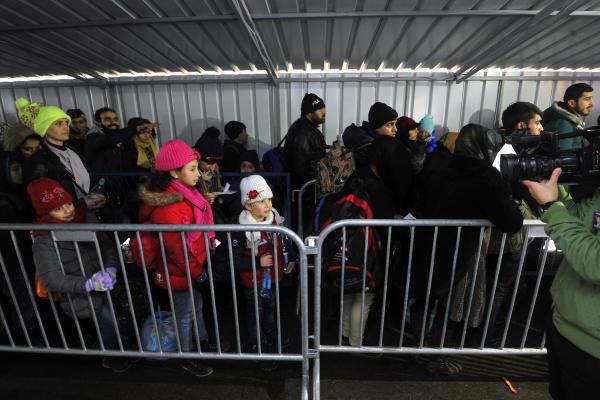
An effective and humane return policy is an integral part of a comprehensive migration and asylum policy.
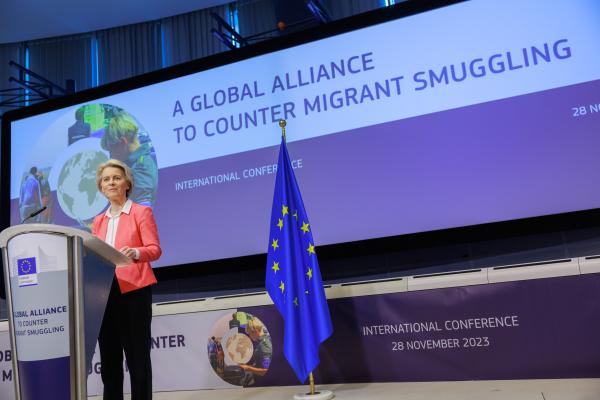
The International Conference on a Global Alliance to Counter Migrant Smuggling is taking place on Tuesday 28 November 2023, in Brussels.

The EU Return Coordinator's main task is to bring together different strands of EU return policy, supporting its consistent and coherent implementation, and to establish a common EU system for returns.
Improving external border controls
The Commission takes strong action to prevent irregular migration through ensuring that each EU country controls its own portion of EU's external borders. Commission actions also aim to reinforce the effectiveness of EU’s migration management system and to ensure that fundamental rights of migrants are respected.
Such actions include legislative measures, some of which are already adopted and are now being implemented, while others continue to be discussed by legislators (i.e. the Council and the European Parliament). These include:
- strengthening the mandate of FRONTEX to increase its effectiveness on external borders,
- establishing an evaluation mechanism to verify the correct application of Schengen rules,
- intensifying the coordination between border surveillance authorities (through the European Border Surveillance System – EUROSUR), as well as considering the feasibility of creating a European system of border guards and
- establishing rules for external sea border surveillance in the context of operational cooperation coordinated by FRONTEX.
Overview of important events and developments
- Legal framework on migrant smuggling
In 2002, the EU adopted a legal framework on smuggling, composed of a Directive defining the facilitation of unauthorised entry, transit and residence and a Framework Decision strengthening the penal framework for these offenses.
In line with the Pact on Migration and Asylum, the Commission has issued guidance on the implementation of the EU rules on definition and prevention of the facilitation of unauthorised entry, transit and residence (C(2020) 6470 FINAL). It recalls that EU law does not allow the criminalisation of humanitarian activity, which is mandated by law, and it invites Member States to distinguish between the activities carried out for the purpose of humanitarian assistance and the activities that aim to facilitate irregular entry or transit, in order to exclude the former from criminalisation.
- European Agenda on Migration and European Agenda on Security
The number of irregular migrants entering the EU reached unprecedented levels during 2015 and remained high in 2016. During 2016, EU countries reported new arrivals from Africa, the Middle East and Asia, many of whom turned to criminal networks of smugglers for assistance.
To prevent the exploitation of migrants by criminal networks and to reduce incentives for irregular migration, both the European Agenda on Migration and the European Agenda on Security identified the fight against migrant smuggling as a priority.
- A renewed EU action plan against migrant smuggling (2021-2025)
On 29 September 2021, the Commission adopted a renewed EU action plan against migrant smuggling for the period 2021-2025. It strengthens operational cooperation, and information exchange between EU countries and EU law enforcement agencies to investigate, and prosecute migrant smuggling networks.
It covers areas such as financial investigations, asset recovery, document fraud, and digital smuggling. The renewed EU action plan adopts a comprehensive approach and seeks even closer cooperation with partner countries along the migratory routes towards the EU. The renewed EU action plan builds on successful actions that were launched through the EU Action Plan against Migrant Smuggling for the period 2015-2020.
- Rules against trafficking in human beings and Employers Sanctions Directive
Migrants in an irregular situation are more vulnerable to labour and other forms of exploitation. Trafficking in human beings is a different, yet interlinked crime, and the EU has established tougher rules for action against criminals engaged in human trafficking.
EU rules make sure that victims of trafficking have access to assistance, including the possibility of a temporary residence in the EU when they cooperate with law enforcement authorities or, for those Member States who foresee it, irrespective of their cooperation. The EU also monitors the implementation of the Employers Sanctions Directive, making sure that employers who employ irregular migrants are appropriately sanctioned, and that the irregular migrants can exercise their rights to claim back wages and social contributions.
The Communication on the Employers Sanctions Directive, adopted on 29 September 2021, looks at the practical implementation of the Directive and identifies actions to strengthen its implementation focusing on three main actions: sanctions against employers, measures to protect the rights of irregular migrants, and inspections.
- Regulation on the creation of a European network of immigration liaison officers (ILO network)
As part of the EU Action Plan against migrant smuggling (2015-2020), a new Regulation was proposed by the Commission and adopted by the co-legislators in 2019 to step up the cooperation between liaison officers of the European Commission, EU agencies and Member States that are deployed in third countries. The ILO network aims to improve the exchange of information on migration, adopting a coordinated approach in cooperation with third country authorities. The activities of ILOs are of great importance to prevent irregular migration, fight migrant smuggling, facilitate readmission of irregular migrants, and facilitating legal pathways towards the EU.
- EMPACT
In 2010, the EU set up the EU policy cycle for organised and serious international crime, better known under the name EMPACT (European Multidisciplinary Platform Against Criminal Threats).
Among the EU crime priorities for the EU policy cycle 2018-2021, is the EMPACT crime priority Facilitation of Illegal Immigration (FII). EMPACT FII is a structured, multidisciplinary co-operation platform among EU Member States for disrupting Organized Criminal Groups which facilitate illegal immigration. At the heart of EMPACT FII, are the yearly updated Operational Action Plans, which outline important operational actions of EU countries and EU agencies (Europol, Frontex, Eurojust, CEPOL, eu-LISA, etc.) on fighting migrant smuggling.
For the period 2022-2025, EMPACT will have a dedicated priority on migrant smuggling. The Commission participates in discussions of the Operational Action Plans and meetings, and provides financial support to their implementation.
- Pact on Migration and Asylum
The Pact on Migration and Asylum adopted on 23 September 2020 sets out improved and faster procedures throughout the asylum and migration system and sets in balance the principles of fair sharing of responsibility and solidarity. This is crucial for rebuilding trust between Member States and confidence in the capacity of the European Union to manage migration.
- EU Strategy on voluntary return and reintegration
On 27 April 2021, the Commission adopted the EU strategy on voluntary return and reintegration, which aims at increasing the number of voluntary returns and at improving the quality of the support provided to the returnees. In this way, it improves the overall effectiveness of the EU return system.
Documents
- Pact on Migration and Asylum
- EU strategy on voluntary return and reintegration
- Communication on a more effective return policy in the European Union
- A renewed EU action plan against migrant smuggling 2021-2025
- EU Action Plan against migrant smuggling 2015-2020
- Communication on the Employers Sanctions Directive
- Communication on migration on the Central Mediterranean route
- Partnership Framework: reinforced cooperation with third countries to better manage migration
- Communication on Enhancing cooperation on return and readmission as part of a fair, effective and comprehensive EU migration policy